

Every organization wants better performance.
But most struggle with the same leadership gap:
“We have strategy on paper, but our execution is weak.”
In Nigerian businesses, ministries, NGOs, schools, and startups, leaders often describe the same challenges:
-
Teams are busy, but progress feels slow.
-
People are working, but not working toward the same direction.
-
There are targets, but they do not translate into daily actions.
-
Performance reviews feel subjective, emotional, or unclear.
This gap happens because the organization has not defined success in a measurable and aligned way.
This is where OKRs and KPIs come in.
When used correctly, they help leaders translate strategy into action — without micromanaging and without confusion.
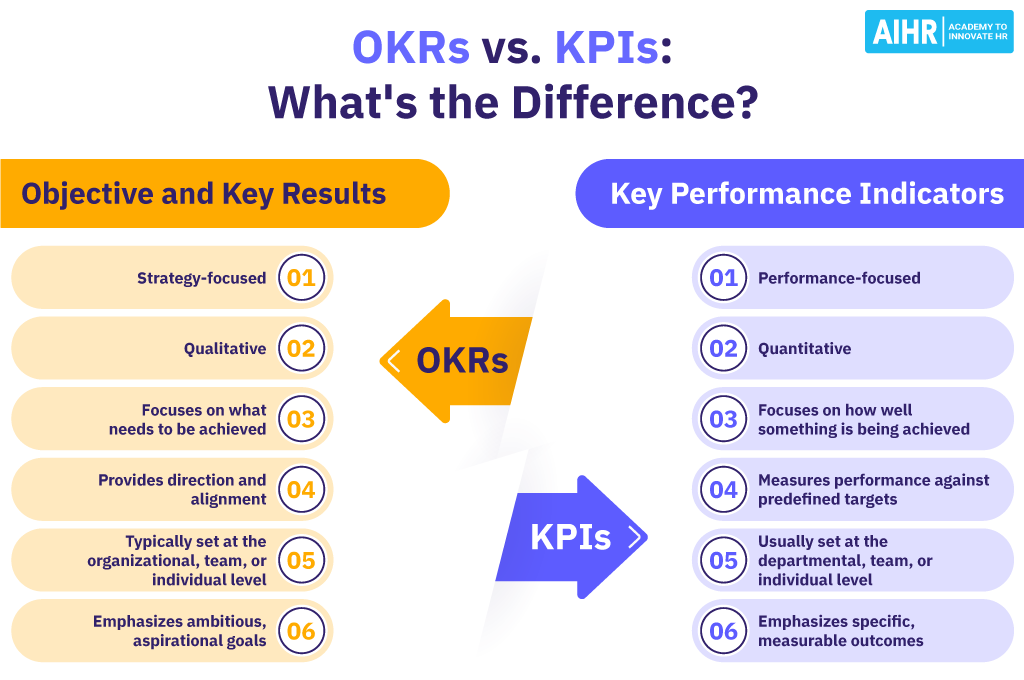
What Are OKRs and KPIs? (Simple Definitions)
KPIs (Key Performance Indicators)
KPIs measure performance.
They show how well a system, person, or department is doing against ongoing expectations.
Examples:
-
Monthly revenue
-
Employee retention rate
-
Customer satisfaction score
-
Number of training sessions completed
KPIs tell us “Did we perform well?”
KPIs = Metrics that show the health of the organization.
OKRs (Objectives and Key Results)
OKRs help teams improve or achieve something new.
They describe:
-
Objective – What we want to achieve (direction, aspiration).
-
Key Results – How we will measure that success (numbers and outcomes).
Examples:
-
Objective: Expand our regional market presence.
-
Key Results:
-
Open 2 new branches in 2025.
-
Acquire 100 new enterprise clients.
-
Achieve 30% brand awareness growth in targeted cities.
-
OKRs tell us “What improvement or change are we driving?”
OKRs = Strategy in measurable form.
Simply:
| OKRs | KPIs |
|---|---|
| Used to improve or change something | Used to monitor performance stability |
| Forward-looking and growth-driven | Ongoing health and performance indicators |
| Defines strategic priorities | Measures operational results |
| Reviewed quarterly | Reviewed monthly or continuously |
Most Nigerian organizations use KPIs only — and that is why they feel stuck.
KPIs tell you where you are,
but OKRs tell you where you are going.
Without OKRs, teams do not grow.
Without KPIs, teams do not sustain growth.
You need both.
Why Most Teams in Nigeria Struggle with Execution
Three core reasons:
1. Strategy is not translated into weekly action.
People understand the vision, but do not know the next steps.
2. Goals are not measurable.
“If we cannot measure it, we cannot repeat it.”
3. Leaders depend on reminders, follow-up, or motivation.
This leads to exhaustion, conflict, and frustration.
A leader should not be chasing performance.
A leader should be maintaining a structured execution environment.
OKRs + KPIs create that structure.
How to Use OKRs and KPIs Together (ALC Alignment Model)
Step 1: Define the Strategic Objective
Ask:
“What are we trying to improve in the next 90 days?”
Examples:
-
Improve customer experience.
-
Strengthen sales conversion process.
-
Develop next-generation leaders internally.
-
Expand program reach across regions.
Step 2: Translate That Objective into Measurable Key Results
Use numbers, percentages, or clear deliverables.
Example:
Objective: Improve customer experience.
Key Results:
-
Reduce customer service complaint resolution time from 72 hours to 24 hours.
-
Increase satisfaction ratings from 3.2 to 4.5 out of 5.
-
Conduct 6 customer feedback review sessions with team members.
Now everyone knows:
-
What success looks like
-
How to measure it
-
And what progress means
Step 3: Support OKRs with KPIs
KPIs ensure performance stability while pursuing growth.
If OKRs are the journey,
KPIs are the dashboard.
Example (continuing above):
-
KPI: Customer satisfaction score
-
KPI: Ticket resolution time
-
KPI: Number of repeat complaints
KPIs ensure the system does not break while improving.
Step 4: Weekly Check-Ins (The Alignment Rhythm)
This prevents drift and confusion.
Use a weekly 10–20 minute review:
This turns strategy into consistent execution.
A Simple Template You Can Use
OKR Template:
KPI Tracker:
Keep these visible:
-
On an office whiteboard,
-
In a shared Google Doc,
-
In a WhatsApp team group,
-
Or on Notion/Asana/Trello.
Visibility drives focus.
Real Nigerian Workplace Example
Organization: Lagos-based NGO
Challenge: Programs impactful, but donor reporting inconsistent.
Transformation:
-
Objective: Improve reporting quality and consistency.
-
Key Results:
-
Submit 100% of donor reports before deadlines.
-
Reduce reporting corrections by 60%.
-
Train team in data documentation framework.
-
-
KPIs monitored weekly:
-
Number of field reports submitted
-
Accuracy score
-
Time from field activity to documentation
-
Outcome:
Better donor confidence → Increased funding → Expanded reach.
This is practical strategy alignment.
Conclusion
Your organization will always have activities.
But activities are not progress.
Progress only happens when:
-
Strategy is measurable,
-
Performance is trackable,
-
And execution is consistent.
Using OKRs and KPIs together creates a leadership advantage:
-
Everyone knows the mission.
-
Everyone knows what success looks like.
-
Everyone knows what to do next.
-
Accountability becomes a culture, not a conflict.
This is how organizations grow — not by pushing harder, but by leading smarter.